Finding the Best Electric Vehicle Charging Stations Near You


.svg)
Why Electric Vehicle Charging Stations Matter for Modern Urban Living
Electric vehicle charging stations are now found in tens of thousands of locations across the United States, making it easier than ever to keep your EV powered up — whether you're at home, at work, or on the road.
Here's a quick look at the main types you'll encounter:
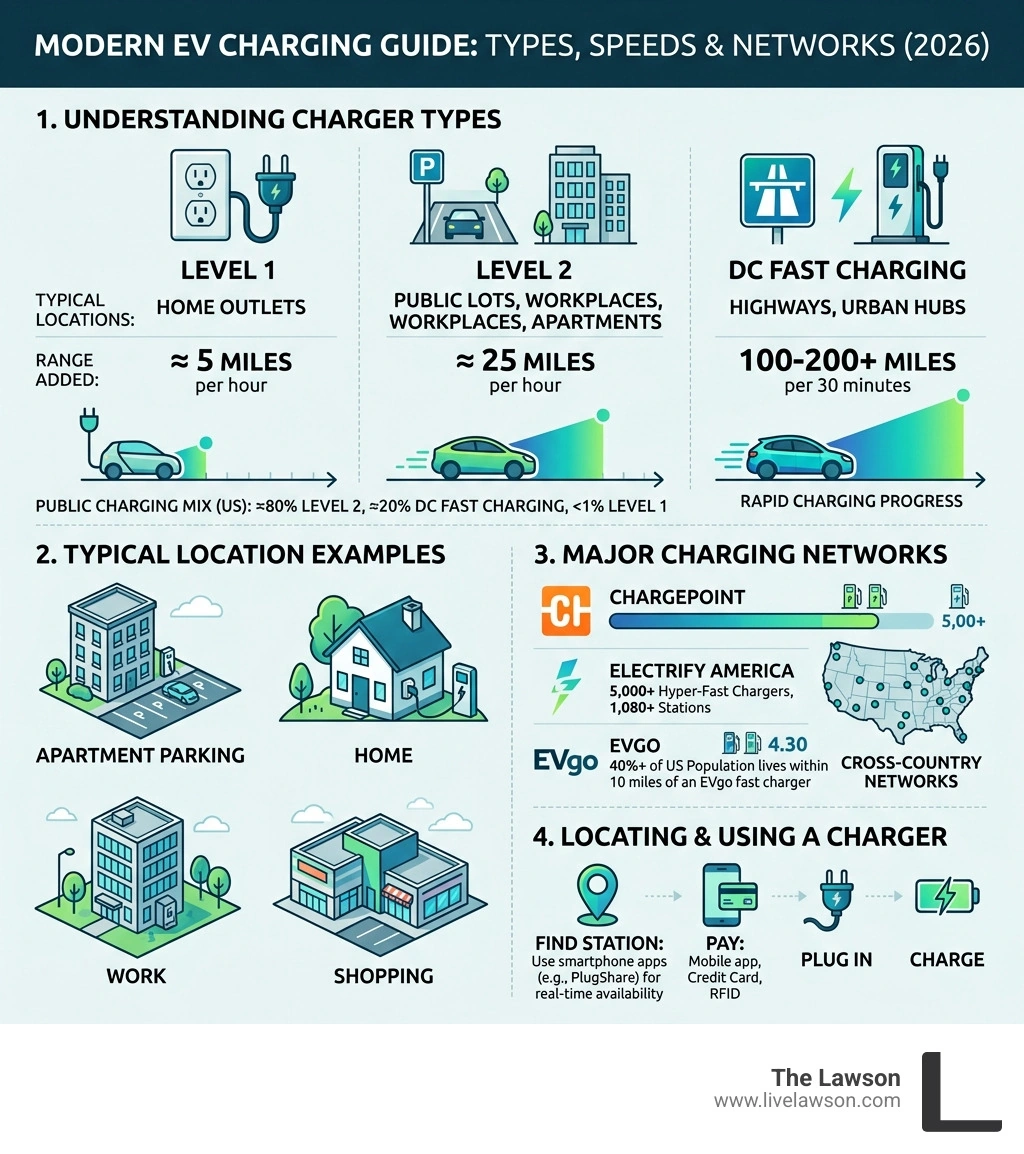
| Charger Type | Typical Location | Range Added |
|---|---|---|
| Level 1 | Home outlets | ~5 miles per hour |
| Level 2 | Public lots, workplaces, apartments | ~25 miles per hour |
| DC Fast Charging | Highways, urban hubs | 100-200+ miles per 30 min |
Nearly 80% of all public charging ports in the U.S. are Level 2, while DC fast chargers make up just over 20%. Less than 1% are Level 1 — so public charging is faster than most people expect.
Major networks like ChargePoint, Electrify America, and EVgo cover enormous ground. Electrify America alone operates 5,000+ hyper-fast chargers across 1,080+ stations in North America. More than 40% of the U.S. population lives within 10 miles of an EVgo fast charger.
Finding a station is simple. Apps like PlugShare show real-time availability, photos, and user check-ins. Most stations accept payment via mobile app, credit card, or RFID card.
The bottom line: charging infrastructure has grown dramatically, and for urban professionals driving EVs, convenient charging is no longer a barrier — it's a given.
Easy Electric vehicle charging stations word list:
Understanding Electric Vehicle Charging Stations: Levels and Speeds
When we talk about Electric vehicle charging stations, we are really talking about three distinct tiers of technology. Understanding these levels is the key to managing your "range anxiety" and making sure you aren't stuck staring at a progress bar when you should be enjoying the San Diego skyline.
Level 1: The "Slow and Steady" Approach
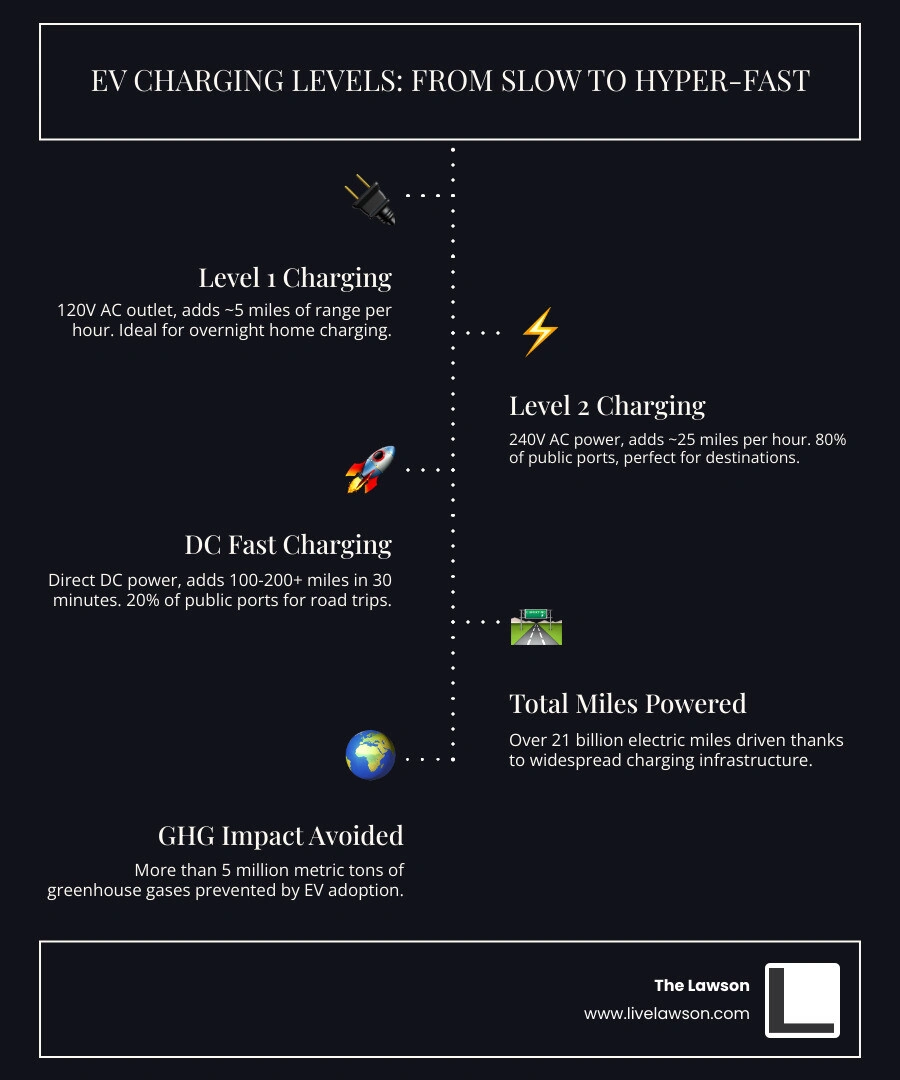
Level 1 charging uses a standard 120-volt AC outlet—the same one you use to plug in your toaster or lamp. While it’s the most accessible form of charging, it is also the slowest. In the public sphere, Level 1 is nearly extinct; as of 2023, less than 1% of public charging ports in the United States were Level 1.
Typically, you’ll get about 5 miles of range for every hour of charging. If you’re parked at home overnight for 8 hours, you’ll wake up with about 40 miles of range. For most urban commuters, this might be enough, but for those of us living active lifestyles in San Diego, it’s rarely the primary solution.
Level 2: The Workhorse of Public Charging
Level 2 charging is the most common type of public infrastructure you will encounter. These stations operate on 240-volt AC power (similar to a clothes dryer outlet). Nearly 80% of all public EV charging ports in the U.S. fall into this category.
At a Level 2 station, you can expect to add roughly 25 miles of range per hour. These are perfect for "destination charging"—places where you plan to spend a few hours, such as the office, a shopping mall, or even EV charging apartments. By the time you’ve finished your workout or a long lunch, your car has regained a significant portion of its battery life.
DC Fast Charging: The "Hyper-Fast" Experience
If you are on a road trip or in a hurry, DC Fast Charging (DCFC) is your best friend. Unlike Level 1 and 2, which provide AC power that the car must convert to DC, these stations provide high-power DC electricity directly to the battery.
According to the Alternative Fuels Data Center: Electric Vehicle Charging Stations, DC fast chargers make up more than 20% of public ports. The speeds are staggering: you can often add 100 to 200+ miles of range in just 30 minutes. This technology is what enables the "coast-to-coast" travel that has become a reality in 2026.
The Environmental and Social Impact
The growth of these stations isn't just about convenience; it's a massive win for the planet. To date, the EV movement has powered over 21 billion electric miles and avoided more than 5 million metric tons of greenhouse gas (GHG) emissions. Every time we plug into one of these Electric vehicle charging stations, we are contributing to a cleaner, more sustainable future for our communities.
Major Networks and Tools for Locating Chargers
In the early days of EVs, finding a charger felt like a scavenger hunt. Today, the landscape is dominated by massive, reliable networks that offer seamless integration with our smartphones.
ChargePoint: The Industry Leader
ChargePoint is a powerhouse in the industry, having deployed more charging ports than anyone else. They don't just operate stations; they enable businesses, fleets, and property owners to host their own. If you’ve ever charged your car at a retail center or a workplace, there’s a high chance it was a ChargePoint station. They are trusted by over 5,000 brands, including a huge majority of Fortune 500 companies. Their modular architecture makes their stations easy to repair, ensuring higher "uptime" for drivers like us.
Electrify America: The Speed Kings
If you see a sign for "Hyper-Fast" charging, you’re likely looking at an Electrify America station. They boast 5,000+ Hyper-Fast chargers across 1,080+ stations in North America. They focus on high-traffic corridors and urban hubs, ensuring you can get back on the road in minutes. You can easily Locate a Charger using their interactive map, which even shows "Coming Soon" locations so you can plan for future routes.
EVgo: Accessibility and Experience
With 15 years in the business, EVgo is a veteran of the charging world. They operate over 1,200 public fast charging stations nationwide. One of their most impressive stats is that more than 40% of the U.S. population lives within 10 miles of an EVgo fast charger. They’ve made charging incredibly simple with features like "Autocharge+," which allows you to start a session just by plugging in—no app or card required once you've set it up. Check out their network at EVgo | Electric Vehicle (EV) Charging Stations - EV Fast Chargers.
Membership Perks and Payments
Most of these networks offer memberships that can save you a significant amount of money. For example, Electrify America’s Pass+ members can save roughly 25% on charging costs. Payment is usually handled through:
- Mobile Apps: The most common method, allowing you to monitor your session in real-time.
- RFID Cards: A simple tap on the station.
- Credit Cards: Most modern stations now include a physical card reader for guest access.
How to Find Electric Vehicle Charging Stations Near You
Locating a station in 2026 is as easy as finding a coffee shop. While network-specific apps are great, "aggregator" tools provide the most comprehensive view.
PlugShare is the gold standard for many of us. It’s a community-driven map where users post photos, report broken chargers, and "check-in" so you know if a station is currently occupied. If you are navigating through the city, you can find San Diego, California EV Charging Stations - PlugShare listings that cover everything from private garage chargers to the high-powered Superchargers on A Street.
For those of us living in San Diego, the infrastructure is particularly robust. Between the County of San Diego's sustainability initiatives and private networks, there are hundreds of options within a short drive of the 92102 area. Whether you are heading to Balboa Park or commuting to the coast, a quick check of your favorite app will ensure you never run low on juice.
Connector Standards and Vehicle Compatibility

One of the most confusing parts of owning an EV used to be the "plug problem." Would the charger actually fit your car? Thankfully, the industry has moved toward standardization, but there are still a few key terms you need to know.
The J1772 and CCS Standards
For a long time, the J1772 was the standard for Level 1 and Level 2 charging in North America. If you have a non-Tesla EV, this is almost certainly what you use for home and destination charging.
For fast charging, the CCS (Combined Charging System) became the dominant standard for most manufacturers like Ford, GM, and Volkswagen. It essentially adds two large DC pins to the bottom of a J1772-style plug.
The Rise of NACS (J3400)
The biggest news in Electric vehicle charging stations recently has been the widespread adoption of the North American Charging Standard (NACS), also known as J3400. Originally Tesla’s proprietary plug, it is now being adopted by almost every major automaker.
What does this mean for you? It means that in the very near future (and for many of us already), the "Tesla Supercharger" network is opening up to other brands. If your car doesn't have a native NACS port, you can usually use an adapter to bridge the gap. You can find more details on hardware compatibility through EVSE | Electric vehicle (EV) charging stations | ChargePoint.
CHAdeMO: The Legacy Plug
You might still see the CHAdeMO plug at some older fast-charging stations. This was primarily used by the Nissan LEAF and some Mitsubishi models. While still supported by networks like EVgo and Electrify America, it is slowly being phased out in favor of CCS and NACS.
Innovations in Electric Vehicle Charging Stations
The technology isn't standing still. We are seeing incredible innovations that make the charging experience even smoother:
- Wireless Charging: Inductive charging pads are being tested that allow you to charge just by parking over a specific spot. No cables required!
- Revel Urban Hubs: Companies like Revel are focusing on high-density urban environments. With 100 live stalls and over 260+ coming soon, they are proving that you can provide Fast Charging for Urban EV Drivers | Revel even in the heart of a busy city. They’ve already charged over 21.5 million kWh, showing just how much demand there is for urban fast-charging.
- Battery Energy Storage (BESS): Networks are now using giant on-site batteries to store energy during off-peak hours and deliver it to your car during the day. This stabilizes the grid and ensures "Hyper-Fast" speeds even when everyone else is using electricity.
Frequently Asked Questions about EV Charging
We know that transitioning to an electric lifestyle comes with a learning curve. Here are the answers to the questions we hear most often.
How long does it take to charge an EV at a public station?
This depends on two things: how much energy your car can accept and how much the station can provide.
- At a Level 2 station: Think of this as a "top-off" while you work or sleep. You’ll get about 25 miles of range per hour.
- At a DC Fast Charger: This is for when you're on the move. Most modern EVs can go from 10% to 80% charge in about 20 to 30 minutes.
Pro tip: Charging slows down significantly after your battery hits 80% to protect the battery’s health. If you’re at a busy station, it’s often polite (and faster for your trip) to unplug at 80% and get back on the road!
Are all electric vehicle charging stations compatible with every car?
Almost! While there are different plug types (CCS, NACS, CHAdeMO), adapters are widely available. Most public stations are "open," meaning they serve all car brands. Even the Tesla Supercharger network is now becoming accessible to non-Tesla vehicles through NACS adoption and "Magic Dock" adapters. Before you head out, just check your app to ensure the station has a connector that matches your car or adapter.
How do I pay for a charging session?
Gone are the days of fumbling with coins. Most sessions are started via:
- Smartphone Apps: Download the ChargePoint, EVgo, or Electrify America apps. You can link your credit card and just swipe to start.
- RFID Cards: Many networks will mail you a small card or key fob that you can tap on the station.
- Credit Cards: Look for the card reader on the station’s face.
- Plug & Charge: If your car supports it, the station recognizes your vehicle the moment you plug in and bills your account automatically.
Luxury Living and Sustainable Transit in San Diego
As we look toward the future of urban living, it’s clear that sustainability and luxury go hand-in-hand. At The Lawson, we believe that your home should reflect your values and your lifestyle. Located in the heart of San Diego at 2935 A Street (92102), our luxury apartment communities are designed for the modern professional who demands both comfort and convenience.
Imagine starting your day with a workout in our state-of-the-art gym, followed by a refreshing session in the sauna or a dip in the hot tub and cold plunge. As an EV driver, you can rest easy knowing that the infrastructure you need is right at your fingertips, whether you're utilizing apartment parking solutions or the nearby high-speed charging hubs.
After a day of exploring everything San Diego has to offer—from the vibrant downtown scene to the beautiful coastline—you can head up to our rooftop sky deck. There’s nothing quite like taking in the breathtaking skyline views as the sun sets, knowing you’re part of a community that embraces the future of transit and sustainable living.
Our expansive units, ranging from studios to two-bedrooms, provide the perfect sanctuary. We invite you to experience a lifestyle where premium amenities and environmental responsibility meet.
Ready to see the view for yourself? Visit us at www.livelawson.com to learn more about our community and find your next home in the heart of San Diego.

Related Posts

CONTACT US
Everything starts with hello. Fill out the form below to stay in the loop with updates on The Lawson.
.jpg)